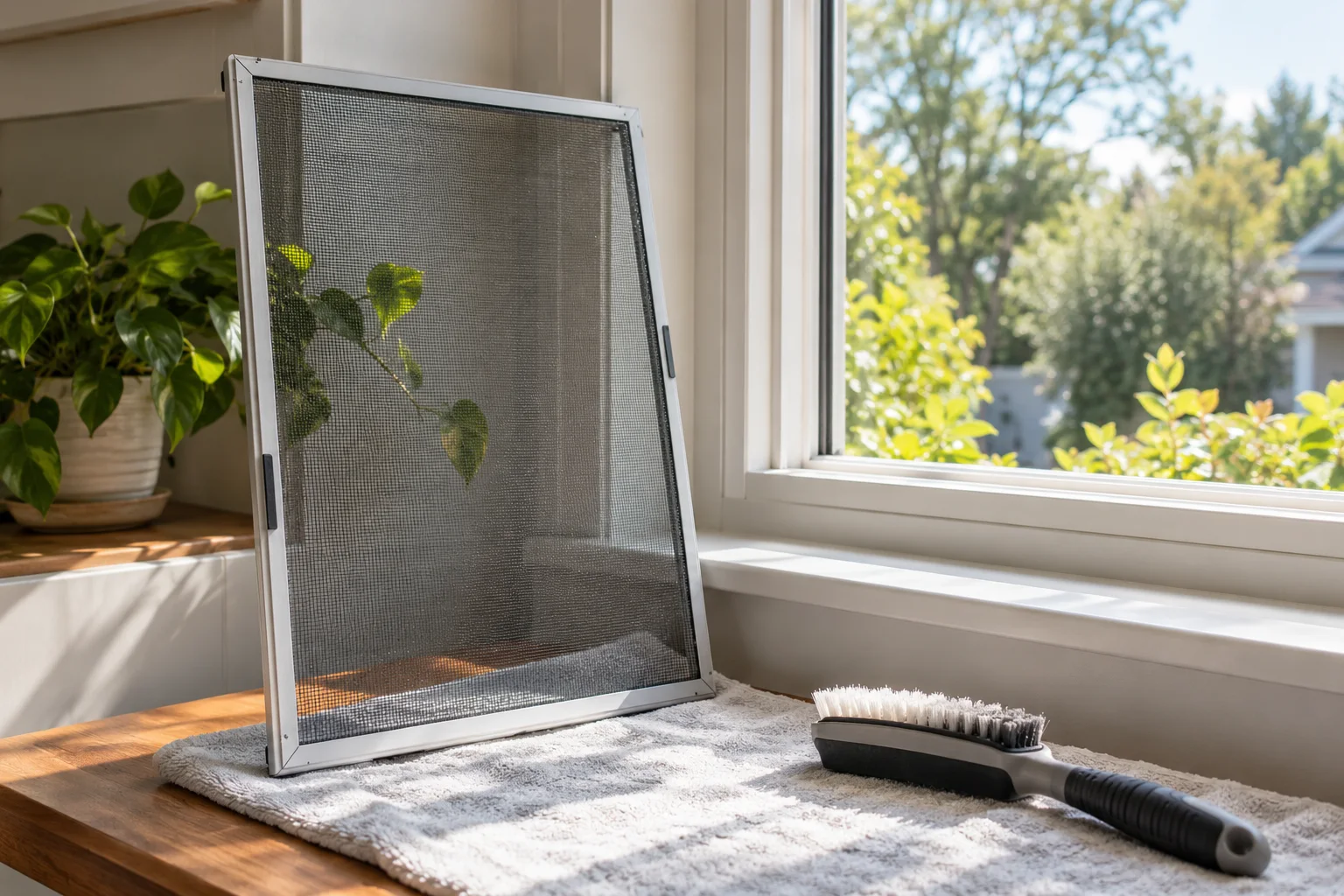
A torn screen is easy to notice when the evening air finally feels worth letting inside. The repair seems obvious: replace the mesh and enjoy the breeze. Yet the mesh is only one part of the assembly. A bowed frame, missing retaining tab or sliding door that no longer runs properly can change what needs attention and what a useful repair should include.
Before requesting help, identify the screen, describe the damage and consider how the window or door is used. A few clear photographs can prevent a provider from arriving prepared for a simple mesh replacement when the real problem is a damaged frame or unfamiliar hardware. This guide helps you organize that information without dismantling a screen or attempting awkward access.
Identify each screen by its opening
Give each screen a room and position, such as the left kitchen window or the sliding patio door. If several look identical, number them on a simple list. Screens that appear interchangeable can differ in dimensions, tabs or attachment details. Keeping their locations clear is useful throughout removal, repair and reinstallation.
Photograph the complete opening as well as the damaged area. A close view of a tear does not show whether the screen slides, clips into place or belongs to a larger assembly. Include any visible label or manufacturer marking that can be read without taking components apart.
Describe whether the screen is currently installed. A loose screen stored in the basement presents a different job from one at an upper floor window. If it has already been removed, explain who removed it and whether all parts are present. Keep loose clips or tabs in a labelled container with the correct screen.
Do not assume the provider will remove and reinstall screens as part of a quoted mesh repair. Some services work on frames you deliver; others handle the complete visit. Ask explicitly which arrangement applies and whether access to the opening changes the scope.
Describe the mesh damage and the frame condition separately
A small puncture, a long tear and mesh pulling out along an edge are different observations. State where the problem is and whether it is spreading. If you know what caused it, include that information. Repeated contact from a pet or a door handle may influence the material or protection discussion.
Look at the frame from a safe position. Note a visibly bent side, separated corner or missing retaining component. Avoid trying to straighten it before assessment. A frame that has lost its shape may not produce a satisfactory result simply by receiving new mesh.
Describe fit as well as appearance. Does the screen sit securely in its intended position? Is there an obvious gap around the edge? Does it rattle or come loose during normal use? These symptoms may involve the frame or attachment rather than the mesh itself.
For a sliding screen door, separate mesh damage from movement problems. A dragging panel, damaged track or latch that does not meet properly may need additional work. The provider should know whether you want only a new screen surface or an assessment of the complete door's operation.
Decide whether a patch or full replacement suits the goal
A localized repair may be worth discussing for a small defect where appearance is secondary. Ask what the repair will look like and whether it suits the particular mesh. A patch can be visible, and the surrounding material may already be worn. The provider should explain the likely result before you choose.
Full mesh replacement may offer a more consistent appearance when damage is extensive or the existing material is tired. That does not necessarily mean the frame also needs replacement. Ask the provider to distinguish these decisions rather than treating a torn screen as an automatic reason to buy a whole new assembly.
If the frame is damaged, replacement or specialist repair may be the more sensible scope. Compatibility with the window or door matters. A newly made frame must fit and be retained properly, not simply approximate the dimensions of the old one. Provide product information wherever possible.
Consider the screen's visibility in the room. A small patch in a utility window may be acceptable, while a prominent patio door may justify a more uniform finish. The right choice depends on condition and expectations, not on an assumption that every screen must receive the same treatment.
Choose material around use and trade-offs
Phifer offers different screening products and selection guidance because mesh characteristics vary. Ordinary insect screening, products intended for greater durability and specialized light or solar screening are not identical choices. Ask about the actual material proposed rather than agreeing to an undefined premium screen.
Tell the provider what matters most: the view, airflow, insect exclusion, resistance to ordinary wear or another specific concern. Those priorities may involve trade-offs. A denser or heavier material can change the appearance and feel of the opening, so ask to see a sample where possible.
If pets repeatedly contact the screen, discuss both material and behaviour. A more durable mesh may suit the application, but it should not be treated as a secure barrier for an animal. Consider whether the door's use or surrounding arrangement needs to change to prevent recurring damage.
Specialty products must suit the existing frame and installation system. Phifer's repair resources include guidance on matching spline to the frame groove, illustrating why mesh and retaining components should be considered together. Leave the exact compatibility decision to the provider using the product information.
Keep insect screening separate from fall protection
An ordinary insect screen is not a fall prevention barrier. Government of Canada injury information includes children pushing through window screens among reported falls. A freshly repaired screen should not create confidence that an open window can safely support a person leaning against it.
Keep children away from open window hazards and consider furniture placement around the opening. If the concern is fall prevention, seek appropriate window safety advice and suitable products for that purpose. That is a different project from mesh replacement and should be described separately.
The same distinction applies to security. A screen that closes neatly is not a substitute for the window or door's security hardware. If the locking function is defective, arrange assessment of the relevant component. Do not let a successful cosmetic repair obscure the need for a separate functional repair.
Discuss any required escape or ventilation function before changing an assembly. A replacement or added accessory should preserve the opening's intended operation and applicable requirements. Where those requirements are uncertain, consult the appropriate building professional or authority rather than improvising a solution.
Plan safe removal and access
Tell the provider the floor level and how the screen can be reached. A window above a stairwell, behind fixed furniture or outside a balcony needs a different access discussion from a ground floor opening. Do not remove screens from difficult locations simply because a drop-off repair appears cheaper.
Ask the provider whether the work can be done from inside, whether specialist access is needed and who is responsible for arranging it. You do not need to prescribe equipment. You do need to give enough information for a realistic decision before the visit.
In a condominium or rented home, check ownership and permission. The screen or window assembly may be subject to building rules, and exterior access may require coordination. Obtain the relevant information before ordering a custom replacement or arranging a provider who expects unrestricted access.
If the screen will be absent for a period, plan how the opening will be used. Keep the window or door managed appropriately while the repair is underway. An empty opening can change insect control, pet management and the household's routine, particularly during warm weather.
Make measurements useful without turning them into guarantees
Provide approximate dimensions only where they can be obtained safely. State whether you measured the visible mesh, the outer frame or the opening. Those are different measurements, and an unlabeled number can lead to an incorrect assumption.
For a custom replacement, agree who takes final measurements and confirms the attachment details. A supplier may need an original frame or a site visit. Ask what their measurement process includes and what happens if the existing opening is irregular.
Do not rely on a nominal window size to order a screen. The screen assembly can have its own dimensions and retention system. Even similar windows in the same house may have been replaced at different times. Product labels and an opening-by-opening record reduce confusion.
If the provider requests a template or a delivered frame, ask how to package and transport it. Long, thin frames can be awkward to carry. Avoid bending them to fit a vehicle or stacking heavy items on them. A repairable frame should arrive in the same condition in which it was assessed.
Consider cleaning and nearby maintenance as separate choices
A newly repaired screen may make dirt in the surrounding track more noticeable. Decide whether cleaning is part of the request. Screen repair, frame cleaning and window track cleaning can be different services, and a repair quote should not be assumed to cover all of them.
Ask what cleaning methods suit the new mesh and frame. Follow the manufacturer's guidance rather than using aggressive tools or chemicals out of habit. A specialist material may have different care instructions from the old screen.
If the window itself is difficult to operate, mention that before the visit. The provider may repair screens without servicing window hardware. A separate specialist could be needed for a sash, balance or other component. Distinguishing these tasks avoids disappointment when the new mesh does not change the window's movement.
For a sliding screen door, ask whether rollers, latch adjustment or track condition will be assessed. A new mesh can improve appearance while leaving the panel difficult to use. Decide whether that limited result is acceptable or whether you want a broader operational review.
Request a quote with a clear endpoint
The brief should identify each screen and the work you expect. Include whether the provider supplies material, removes and reinstalls the assembly, and handles damaged frame parts. Ask which conditions must be confirmed before the price can be finalized.
A useful request includes the following details:
- A labelled list of windows or doors and their floor levels.
- Wide and close photographs showing mesh, frame and retaining hardware.
- The damage, fit and operating symptoms for each assembly.
- Available manufacturer information and preliminary dimensions.
- Material priorities, appearance expectations and permission requirements.
- Removal, transport, cleaning, reinstallation and disposal responsibilities.
Compare the same scope. A mesh-only price for a delivered frame is not directly comparable with a complete onsite service. A replacement frame using a particular system may also differ from a generic repair. Ask providers to explain the distinction so the total reflects the result you need.
Agree what happens if a hidden crack or unavailable part is found. The provider should contact you with the revised options before proceeding. Sometimes the practical choice is a different repair or a specialist replacement, and that decision belongs in a clear conversation rather than an unexpected invoice.
Prepare for the visit and keep the parts organized
Clear the area around the opening and move small items from the sill. Discuss large furniture that blocks access. Keep pets in another room, particularly if a door or window will be open during the work. Tell household members which openings are temporarily unavailable.
If several screens are removed, maintain their labels throughout the job. A simple room-and-position system helps ensure each returns to the correct opening. Ask the provider whether labels should be attached in a particular way to avoid damage or confusion.
Keep the new material information and any replacement part numbers. This is helpful if one screen needs repair again or you later want matching material in another room. The appearance of an installed mesh may be difficult to identify from memory months later.
At handover, review fit and ordinary operation with the provider. Check that the assembly is retained as intended and that the window or door still works normally. Ask about care and any limitations of the repair. Do not lean on the screen or perform improvised strength tests to assess it.
Make the repair last through ordinary habits
Think about the cause of the original damage. If a garden chair repeatedly contacts the patio door, moving the chair may protect the new mesh. If stored screens are being crushed each winter, a labelled protected storage location may be the useful follow-up. A small change in routine can matter more than choosing a heavier material.
Notice new tears or loose edges early and seek advice before they spread. Avoid repeatedly pushing a detached edge back with household tools. The retaining system and frame condition should be assessed if the problem returns. Recurrence is useful information, not simply a reason to repeat the same repair indefinitely.
For work involving nearby window coverings, the curtain and blind planning guide helps preserve access and operation. The handyman visit guide can help group ready maintenance tasks. Cody's handyman page remains a waitlist while a partner is recruited. A clear screen inventory will help when suitable repair help is available, and it keeps a simple mesh request connected to the opening you actually want to use.